
Pepperstone, Trade Nation, IG, and City Index are among the most discussed names in today’s broker spread comparison market, especially for Forex, Gold, and Indices trading. However, the lowest advertised spread does not always mean the lowest real trading cost, particularly during volatility, news events, or fast market execution conditions.
Broker Comparison Summary
- Trade Nation: Fixed spreads and stable index pricing. Suitable for active CFD traders who prioritize predictable trading costs.
- Pepperstone: Raw ECN spreads with fast execution. Best for scalpers and high-frequency Forex traders.
- IG: Strong regulation and broad market access. Suitable for traders prioritizing broker reputation and global market coverage.
- City Index: Balanced spreads with strong indices offering. Fits multi-asset traders wanting stable trading conditions.
- Capital.com: Competitive spread-only pricing and beginner-friendly platform. Suitable for retail traders seeking simplicity.
- easyMarkets: Fixed spread focus with built-in risk management tools. Better for beginners and volatility-sensitive traders.
- Spreadex: Competitive Forex and spread betting pricing. Suitable for UK-based short-term CFD traders.
- eToro: Social trading and multi-asset investing platform. Better for casual investors rather than active scalpers.
So, in this broker spread comparison guide, we will break down 8 popular brokers and their spread behavior across Forex, Gold, and Indices markets. It also compares pricing transparency, execution quality, and overall trading cost structure to help traders choose a broker that better fits their trading style.
Disclaimer: Spread data, pricing structures, and trading conditions may change over time depending on market liquidity, volatility, account type, and broker updates. This article is for informational and comparison purposes only and should not be considered financial advice or a recommendation to trade.
1. What Is Spread in Forex Trading?
In forex, spread is the difference between the buy price (ask) and the sell price (bid) of a currency pair. It works as one of the main trading costs charged by brokers whenever you open a position. In simple terms, the smaller the spread, the lower your entry cost.
Spread = Ask Price – Bid Price
For example, if EUR/USD has:
- Ask price: 1.2548
- Bid price: 1.2544
- Spread = 1.2548 - 1.2544 = 0.0004 (or 4 pips)
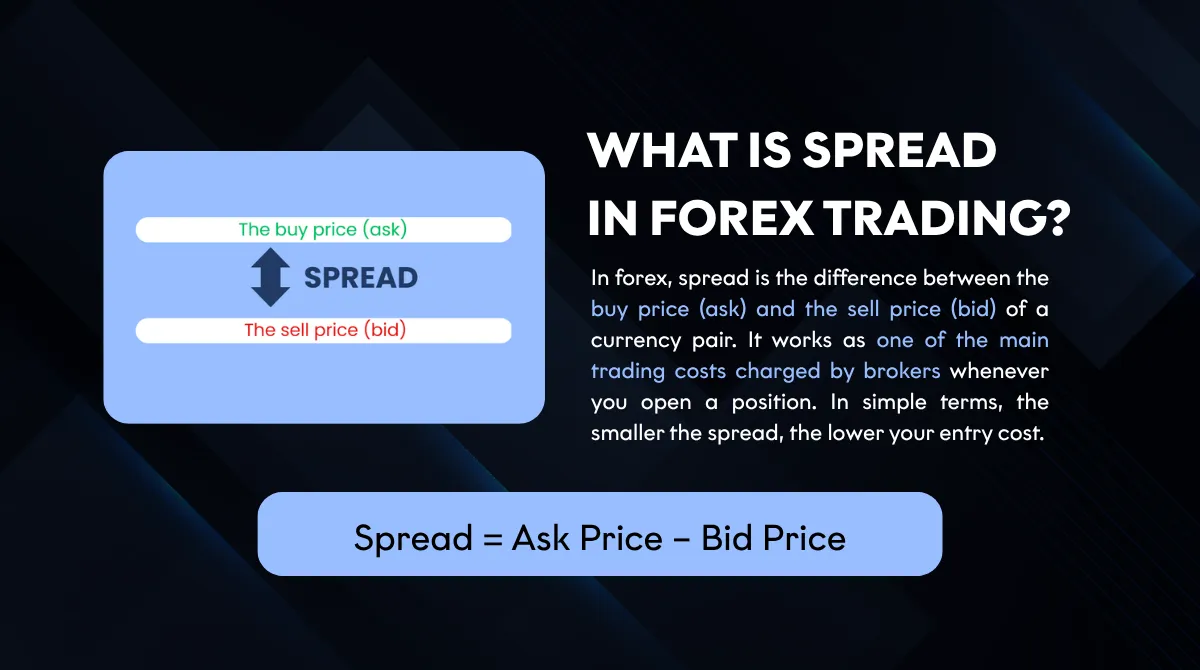 Spread is the difference between the buy price (ask) and the sell price (bid) of a currency pair
The difference is 0.0004, equal to 4 pips. That means every trade starts slightly negative because traders must first cover the spread cost before making a profit.
Spread sizes can vary depending on market volatility, trading session liquidity, account type, and the broker’s pricing model. For active traders, especially scalpers and intraday traders, even small spread differences can significantly affect long-term profitability.
For traders newer to Forex and CFD markets, understanding how CFD trading works can also help explain why spreads behave differently across asset classes.
2. The Three Main Types of Spreads
Forex brokers generally use three main spread models: fixed spreads, variable spreads, and raw/ECN spreads. Each model works differently in terms of pricing, trading costs, and behavior during volatile market conditions. Understanding these differences helps traders choose a broker that better fits their trading style and risk tolerance.
- Fixed Spread: The spread remains stable under most market conditions, making trading costs more predictable. Fixed spreads are commonly preferred by traders who want consistent pricing during volatile sessions or news events.
- Variable Spread: Variable spreads fluctuate based on market liquidity and volatility. They often become tighter during active trading sessions but can widen significantly during major economic news or low-liquidity periods.
- Raw/ECN Spread: Raw spreads offer extremely tight pricing, sometimes starting from 0.0 pips, while charging a separate trading commission. This model is popular among scalpers and high-frequency traders looking for lower direct spread costs.
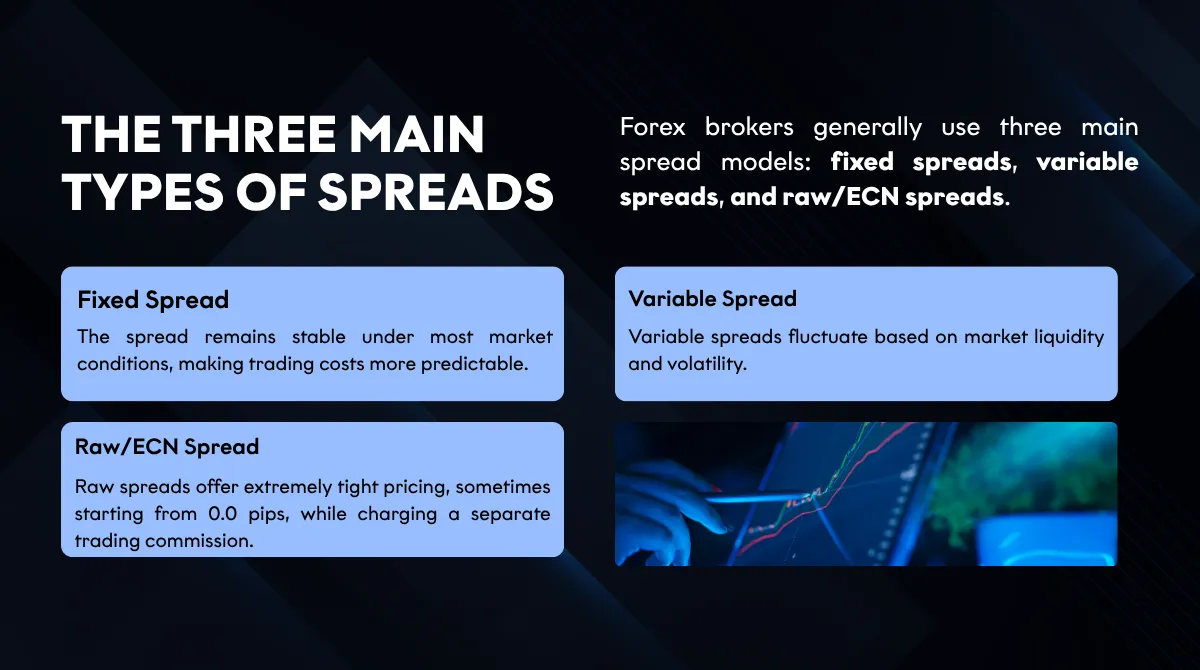 The three main types of spreads
In practice, no spread model is automatically “better” than the others. Some traders prioritize the lowest possible spreads, while others focus more on spread stability, predictable execution, and overall trading cost transparency.
3. Key Points When Choosing Appropriate Broker Spreads
When comparing broker spreads, traders should focus on total trading costs, spread stability, and execution quality rather than simply choosing the broker with the lowest advertised spread. A broker with slightly higher but more stable spreads can sometimes provide a better trading experience than one offering ultra-low spreads with volatile pricing or hidden execution costs.
- Total trading cost matters more than minimum spread: Some brokers advertise ultra-low spreads but charge higher commissions or experience heavier slippage during execution. The real trading cost should always include spread, commission, and execution quality together.
- Understand the spread model: Fixed spreads offer more predictable pricing during volatile sessions, while variable spreads fluctuate based on liquidity and market conditions. Raw/ECN spreads may look lower on paper, but often include separate commissions.
- Check spread stability during volatility: A broker with stable spreads during news releases and active market hours can provide a more consistent trading experience than one that frequently widens spreads during volatility spikes.
- Compare spreads by asset class: Forex pairs, Gold (XAU/USD), and Indices all behave differently. Some brokers may offer competitive Forex spreads but wider Gold or Indices spreads, so traders should compare spreads based on the instruments they trade most.
- Evaluate execution speed and pricing transparency: Tight spreads are less valuable if orders execute slowly, are requoted, or have hidden pricing adjustments. Reliable brokers usually provide transparent pricing policies and stable execution quality across different market conditions.
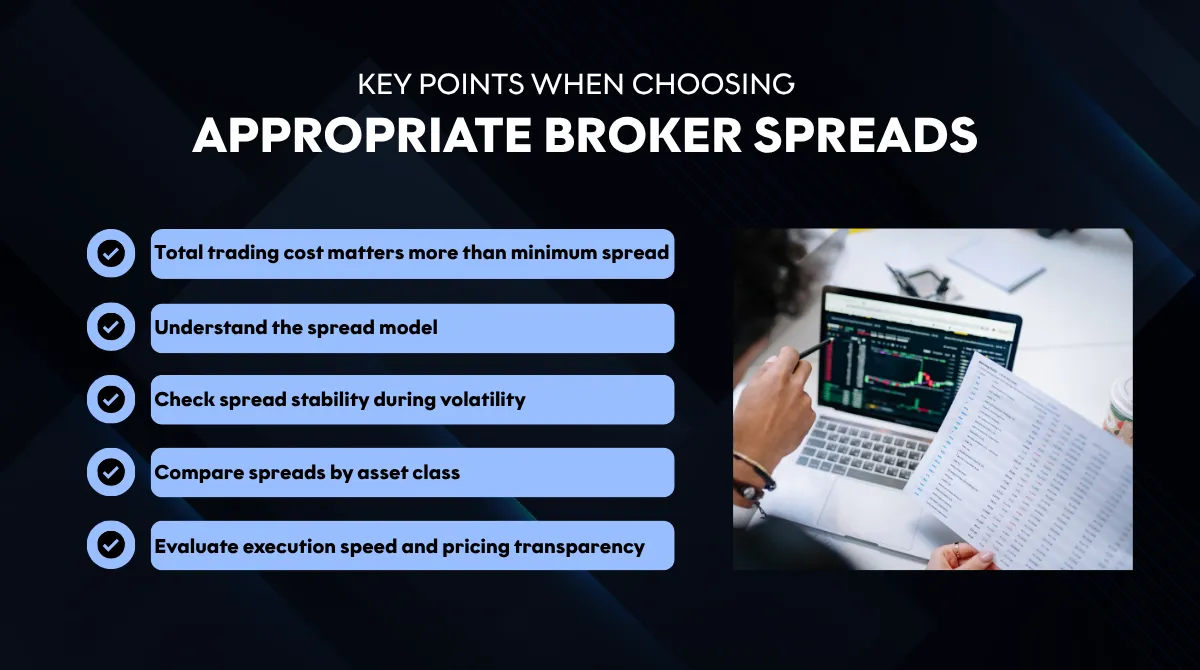 Key points when choosing an appropriate broker spread
Ultimately, the best broker spread depends on a trader’s strategy, trading frequency, and preferred markets. Instead of chasing the absolute lowest spread, traders should focus on total trading cost, pricing transparency, and spread consistency over time.
4. Broker Spread Comparison for Forex, Gold, and Indices
Broker spreads can vary significantly depending on the asset being traded, market volatility, and the broker’s pricing model. Some brokers focus on ultra-low Forex spreads, while others provide more stable pricing for Gold and major Indices during volatile trading sessions. For this reason, traders should compare spreads across the specific markets they trade most often rather than relying only on advertised minimum spreads.
The comparison below highlights how several popular brokers position their spreads across major Forex pairs, and Indices such as US30, NAS100, UK100, and Germany 40. In addition to spread size, factors such as pricing stability, annual trading cost, and execution transparency can also affect the overall trading experience.
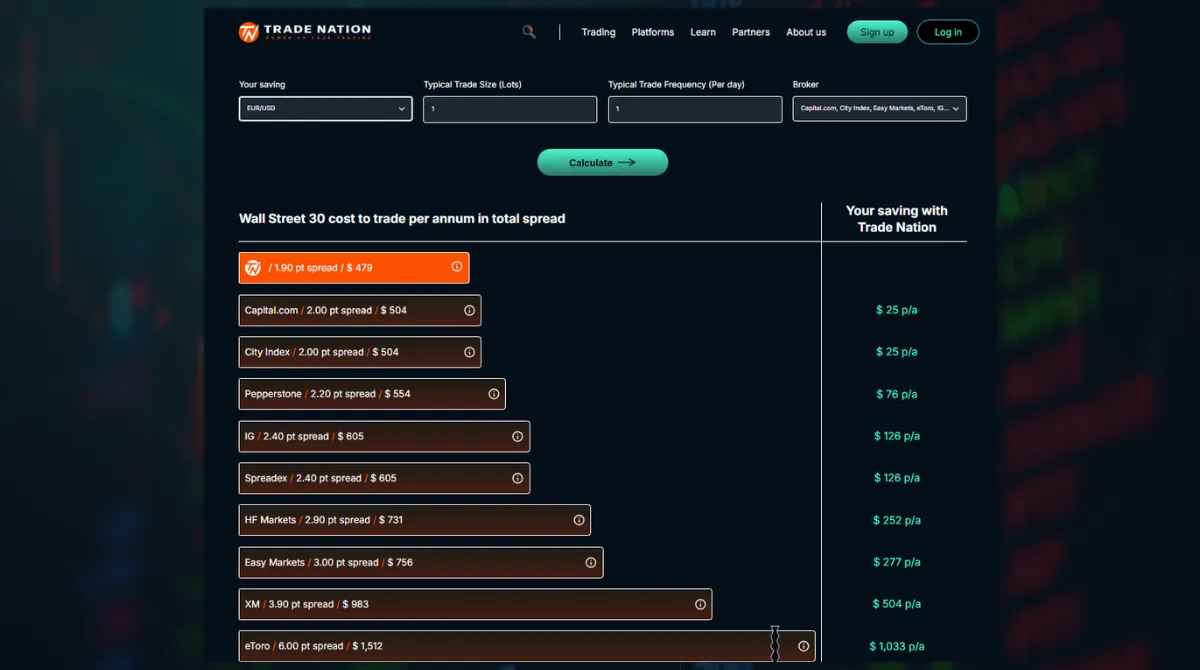 Spread data from publicly available on Trade Nation
| Broker | EUR/USD | GBP/USD | USD/JPY | AUD/USD | XAU/USD | US30 | NAS100 | UK100 | Germany 40 |
|---|---|---|---|---|---|---|---|---|---|
| Trade Nation | 0.50 pts | 0.80 pts | 0.60 pts | 0.40 pts | 0.30 pts | 1.90 pts | 0.90 pts | 0.80 pts | 1.00 pts |
| Pepperstone | 1.10 pts | 1.30 pts | 1.30 pts | 1.10 pts | 0.15 pts | 2.20 pts | 1.20 pts | 1.40 pts | 1.30 pts |
| IG | 0.86 pts | 1.84 pts | 0.96 pts | 1.07 pts | 0.30 pts | 2.40 pts | 1.00 pts | 1.00 pts | 1.20 pts |
| City Index | 0.80 pts | 1.80 pts | 0.80 pts | 0.90 pts | 0.50 pts | 2.00 pts | 3.00 pts | 1.00 pts | 1.20 pts |
| Capital.com | 0.70 pts | 1.40 pts | 1.20 pts | 0.60 pts | 0.30 pts | 2.00 pts | 1.80 pts | 1.00 pts | 1.50 pts |
| Easy Markets | 0.70 pts | 1.30 pts | 1.20 pts | 1.20 pts | 0.30 pts | 3.00 pts | 1.00 pts | 1.00 pts | 1.50 pts |
| Spreade x | 0.60 pts | 0.90 pts | 0.70 pts | 0.60 pts | 0.60 pts | 2.40 pts | 1.00 pts | 1.00 pts | 1.40 pts |
| eToro | 1.00 pts | 2.00 pts | 1.00 pts | 1.00 pts | 1.03 pts | 6.00 pts | 3.72 pts | 1.50 pts | 3.74 pts |
Note: Spread data and pricing information were collected from publicly available Trade Nation sources in February 2026. Actual spreads may vary depending on market conditions, liquidity, account type, and trading session. Figures shown are intended for general comparison purposes only and may change over time.
Overall, the comparison shows that spread differences become more noticeable in Indices trading than in major Forex pairs. Trade Nation stands out for maintaining relatively competitive spreads across both Forex and Indices, particularly on instruments like US30 and NAS100, where spread stability can matter more for active intraday traders.
4.1. Trade Nation
Trade Nation is a multi-asset CFD broker, founded in 2014, and known for its strong focus primarily on fixed spreads, transparent pricing, and simplified trading costs. The broker provides access to thousands of tradable instruments across Forex, Indices, Precious Metals, Commodities, Equities, Bonds, and Cryptocurrencies through platforms including TN Trader, MetaTrader 4, and TradingView integration.
 Trade Nation is a multi-asset CFD broker, founded in 2014
Unlike many brokers that heavily promote ultra-low minimum spreads, Trade Nation positions itself around spread stability and predictable execution costs, particularly for active traders in indices and CFD markets. Its pricing model is designed to reduce unexpected spread widening during volatile trading conditions, which can be an important factor for intraday traders, scalpers, and traders managing tight risk parameters.
| Feature | Trade Nation |
|---|---|
| Founded | 2014 |
| Spread Model | Primarily Fixed Spreads |
| Minimum Deposit | No minimum deposit requirement |
| Trading Platform | TN Trader, MetaTrader 4, TradingView |
| Asset Types | Forex, Indices, Precious Metals, Commodities, Equities, Cryptocurrencies, Bonds |
| Trustpilot Rating | 4.4/5 (Excellent) |
Trade Nation stands out more for its pricing consistency than for aggressively marketing the lowest possible spread numbers. This may not matter much for long-term swing traders, but for active traders executing multiple positions daily, stable spreads can make trading costs easier to estimate and risk management more consistent.
- 0.50 pts on EUR/USD
- 0.60 pts on USD/JPY
- 0.40 pts on AUD/USD
- 1.90 points on US30
Another point worth noting is the broker’s strong positioning in indices trading. Trade Nation publicly compares its spread costs against competitors on products like Wall Street 30, reinforcing its focus on transparent spread comparison rather than relying only on minimum spread advertising.
Traders wanting a deeper breakdown of Trade Nation’s spreads, platforms, regulations, and trading conditions can explore the broker’s detailed profile page for a more complete comparison overview.
4.2. Pepperstone
Established in 2010 in Melbourne, Australia, Pepperstone has grown into one of the most recognized CFD and forex brokers for traders seeking tight variable spreads, fast execution, and institutional-style pricing. The broker offers access to more than 1,300 CFDs across Forex, Indices, Commodities, Shares, ETFs, and Cryptocurrencies through platforms including MetaTrader 4, MetaTrader 5, cTrader, TradingView, and Pepperstone Platform.
 Pepperstone has grown into one of the most recognized CFD and forex brokers
Pepperstone’s core positioning revolves around raw spread trading and low-latency execution infrastructure. The broker highlights spreads from 0.0 pips on Razor account, deep liquidity access from Tier-1 providers, and execution built for active traders, scalpers, and automated trading strategies. Compared with brokers focused on fixed spreads, Pepperstone leans more toward flexible market pricing and execution speed optimization.
| Feature | Pepperstone |
|---|---|
| Founded | 2010 |
| Spread Model | Variable / Raw ECN Spreads |
| Minimum Deposit | $10 |
| Trading Platform | MT4, MT5, cTrader, TradingView, Pepperstone Platform |
| Asset Types | Forex, Indices, Commodities, Shares, ETFs, Cryptocurrencies |
| Trustpilot Rating | 4.3/5 (Excellent) |
Pepperstone mainly offers two pricing structures depending on trading style:
- Standard Account: Spread-only pricing with no separate commission
- Razor Account: Raw spreads from 0.0 pips combined with commission-based pricing
According to Pepperstone’s published pricing structure, Razor account commissions typically start around:
- $3.50 per side on MT4/MT5
- $6–$7 round turn pricing on cTrader and TradingView integrations
However, since Pepperstone primarily uses floating spreads, trading costs can widen during major news events or highly volatile market conditions, especially on Gold and Indices products. Traders who prioritize spread stability may compare it differently from brokers focused on fixed spread pricing.
4.3. IG
IG is one of the most established names in the online trading industry and a constituent of the FTSE 250, established in 1974 in London. The broker offers access to more than 17,000 global markets across Forex, Indices, Commodities, Shares, ETFs, and Cryptocurrencies through platforms including its proprietary web platform, mobile apps, MetaTrader 4, ProRealTime, and TradingView.
 IG is one of the most established names in the online trading industry
IG primarily uses a variable spread pricing model, with spreads built directly into the execution price rather than relying heavily on separate commission structures for most CFD products. The broker publicly displays minimum spreads across different asset classes, giving traders more visibility into its pricing conditions.
| Feature | IG |
|---|---|
| Founded | 1974 |
| Spread Model | Primarily Variable Spreads |
| Minimum Deposit | $0 for bank transfers ($50 for cards) |
| Trading Platform | Web Platform, Mobile App, MT4, ProRealTime, TradingView |
| Asset Types | Forex, Indices, Shares, Commodities, ETFs, Cryptocurrencies |
| Trustpilot Rating | 3.8/5 |
IG advertises minimum spreads from:
- 0.6 points on EUR/USD
- 0.4 points on the S&P 500
- 0.3 points on Spot Gold
The broker is particularly strong in indices trading, offering access to more than 80 international indices alongside CFD trading and spread betting options in supported regions.
Although IG may not always provide the tightest raw spreads for scalpers, the broker is still well-positioned for traders who prioritize long-term broker reputation and market reliability.
4.4. City Index
City Index is a long-established broker launched in 1983 and currently backed by StoneX Group, a Nasdaq-listed financial services company. The broker focuses heavily on Forex, Indices, Commodities, and spread betting markets, offering access to more than 13,500 instruments through WebTrader, mobile trading apps,TradingView, and MetaTrader 4.
 City Index is a long-established broker launched in 1983
| Feature | City Index |
|---|---|
| Founded | 1983 |
| Spread Model | Fixed & Variable Spreads |
| Minimum Deposit | No fixed minimum deposit requirement |
| Trading Platform | WebTrader, Mobile App, MT4, TradingView |
| Asset Types | Forex, Indices, Shares, Commodities, Bullion |
| Trustpilot Rating | 4.2/5 |
City Index supports both fixed and floating spread models depending on the asset traded. The broker publicly displays both minimum and typical spreads, with forex spreads starting from around:
- 0.5 pips on AUD/USD
- 0.6 pips on USD/JPY
- 0.7 pips on EUR/USD
The broker also keeps its pricing structure relatively straightforward, with no fees for deposits or withdrawals and limited commission charges outside share CFDs. Compared with ECN-focused brokers, City Index is positioned more toward traders looking for balanced pricing, broad market coverage, and a stable multi-asset trading environment.
4.5. Capital.com
Launched in 2017, Capital.com is a relatively newer broker compared with legacy trading brands, but it has expanded rapidly in the CFD trading industry. The broker focuses heavily on accessible trading technology, intuitive platform design, and broad multi-asset market coverage. Now that offering access to more than 5,500 markets across Forex, Indices, Commodities, Shares, ETFs, Bonds, and Interest Rates.
 Capital.com is a relatively newer broker compared with legacy trading brands
Capital.com supports multiple trading methods, including CFD trading, spread betting in supported regions, and leveraged trading through its proprietary platform, mobile apps, MetaTrader 4, and TradingView integration.
| Feature | Capital.com |
|---|---|
| Founded | 2017 |
| Spread Model | Variable Spreads |
| Minimum Deposit | 20 USD/EUR/GBP |
| Trading Platform | Web Platform, Mobile App, MT4, TradingView |
| Asset Types | Forex, Indices, Commodities, Shares, ETFs, Bonds, Interest Rates |
| Trustpilot Rating | 4.6/5 |
Capital.com mainly uses a spread-only pricing structure with no separate trading commissions on most CFD products. Based on the broker spread comparison table, Capital.com remains relatively competitive across major forex pairs and indices markets, including:
- 0.70 pips on EUR/USD
- 0.60 pips on AUD/USD
- 2.00 points on Wall Street 30
- 1.00 point on UK 100
Compared with some competitors, Capital.com’s spreads appear more balanced across both Forex and Indices, rather than focusing only on ultra-low pricing in a single asset class. Its EUR/USD and Wall Street 30 spreads are notably tighter than several traditional retail brokers in the comparison table, although Gold spreads remain slightly wider than brokers specializing in metals trading.
4.6. easyMarkets
easyMarkets, launched in 2001, is a retail-focused broker that emphasizes trading simplicity, built-in risk management tools, and stable pricing conditions. The broker is particularly known for targeting traders who prefer a more controlled trading environment during volatile market periods.
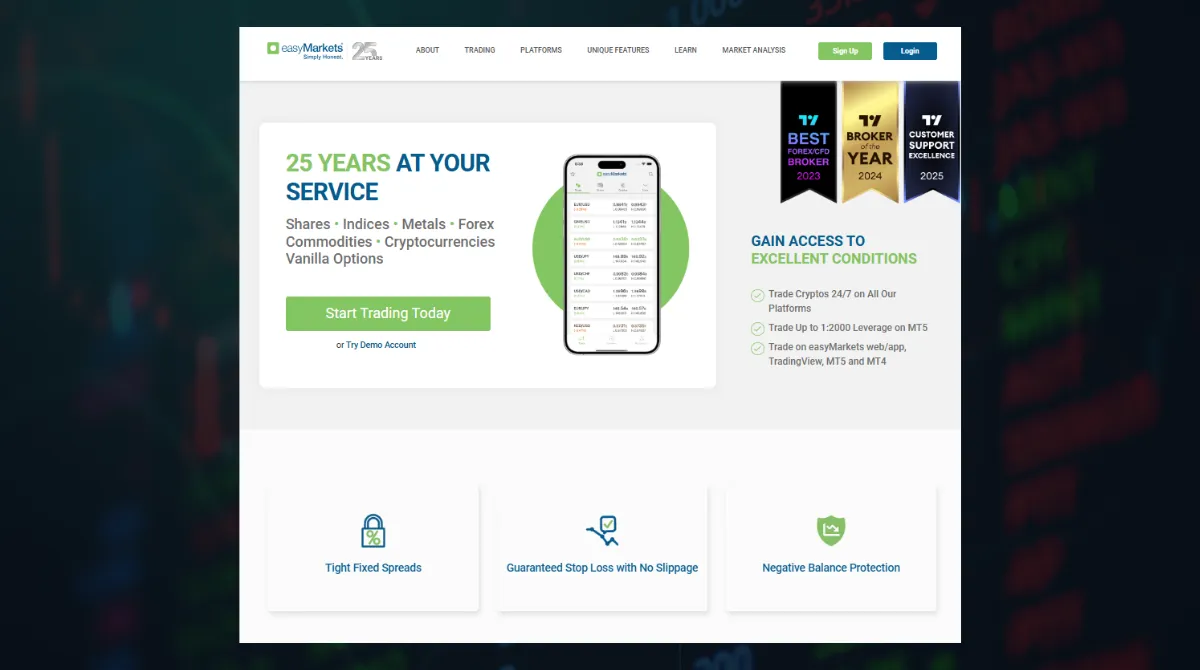 easyMarkets, launched in 2001, is a retail-focused broker that emphasizes trading simplicity
The broker provides access to Forex, Indices, Commodities, Cryptocurrencies, and Shares through its proprietary platform, mobile apps, TradingView, MetaTrader 4, and MetaTrader 5.
| Feature | easyMarkets |
|---|---|
| Founded | 2001 |
| Spread Model | Fixed & Floating Spreads |
| Minimum Deposit | From $25 |
| Trading Platform | easyMarkets Platform, Mobile App, TradingView, MT4, MT5 |
| Asset Types | Forex, Indices, Commodities, Crypto, Shares |
| Trustpilot Rating | 3.9/5 |
easyMarkets offers both fixed and floating spread account structures, depending on the platform and account type selected. On its proprietary Web/App platform, the broker promotes fixed spreads starting from 0.6 pips on EUR/USD, while MT4 and MT5 accounts use more traditional floating spread pricing.
In the broader broker spread comparison table, easyMarkets remains relatively competitive on major forex pairs, although spreads on some indices markets are slightly wider than those of brokers focused purely on ECN-style pricing. For example:
- 0.70 pips on EUR/USD
- 1.20 pips on AUD/USD
- 3.00 points on Wall Street 30
Compared with brokers targeting active scalpers, easyMarkets may appeal more to beginner and intermediate traders who prioritize predictable trading costs and built-in risk management features over raw institutional spread pricing.
4.7. Spreadex
Established in 1999, Spreadex is a UK-based broker specializing in spread betting and CFD trading across global financial markets. The broker focuses heavily on indices, forex, and short-term speculative trading, while positioning itself around competitive spreads, fast account access, and a simplified trading experience.
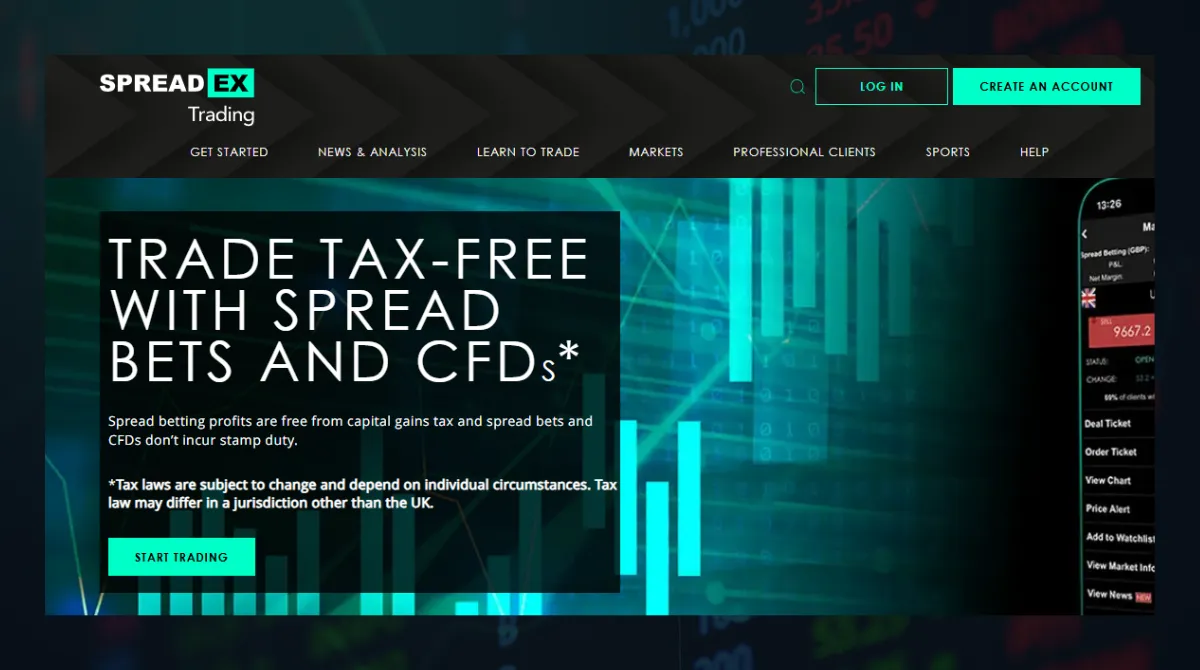 Spreadex is a UK-based broker specializing in spread betting and CFD trading
Spreadex offers access to more than 10,000 markets covering Forex, Indices, Shares, Commodities, Bonds, ETFs, and Interest Rates through its proprietary trading platform and mobile applications.
| Feature | Spreadex |
|---|---|
| Founded | 1999 |
| Spread Model | Mainly Variable Spreads |
| Minimum Deposit | From £5 |
| Trading Platform | Proprietary Web Platform, Mobile App, TradingView |
| Asset Types | Forex, Indices, Shares, Commodities, Bonds, ETFs |
| Trustpilot Rating | 4.3/5 |
Spreadex is particularly active in spread betting markets and promotes competitive pricing on major indices and forex products. Based on the broker spread comparison table, the broker remains relatively competitive across several key instruments, including:
- 0.60 pips on EUR/USD
- 0.90 pips on GBP/USD
- 0.70 pips on USD/JPY
- 2.40 points on Wall Street 30
The platform may suit short-term traders who prioritize straightforward market access, spread betting features, and a simpler account setup experience over advanced institutional trading infrastructure.
4.8. eToro
Founded in 2007, eToro is one of the most recognizable retail trading platforms globally, known for combining multi-asset investing with social trading features. The platform provides access to more than 10,000 assets across Stocks, ETFs, Forex, Indices, Commodities, and Cryptocurrencies through its proprietary web and mobile trading platform.
 eToro is one of the most recognizable retail trading platforms globally
Unlike many traditional CFD brokers that focus heavily on raw spread pricing, eToro positions itself more around accessibility, ease of use, and long-term investing features. The platform is particularly popular among beginner traders and crypto-focused users looking for a simpler all-in-one trading environment.
| Feature | eToro |
|---|---|
| Founded | 2007 |
| Spread Model | Variable Spreads |
| Minimum Deposit | From $50 (varies by region) |
| Trading Platform | Proprietary Web Platform, Mobile App |
| Asset Types | Stocks, ETFs, Forex, Indices, Commodities, Crypto |
| Trustpilot Rating | 4.1/5 |
eToro primarily uses a variable spread pricing structure across Forex, Commodities, and Indices CFDs. According to the broker spread comparison table, eToro generally shows wider spreads than most brokers in this comparison, including:
- 1.00 pips on EUR/USD
- 2.00 pips on GBP/USD
- 6.00 points on Wall Street 30
- 3.72 points on NAS100
- 3.74 points on Germany 40
The broker’s pricing model is structured differently from many ECN or spread-focused CFD brokers. Instead of competing primarily on ultra-tight spreads, eToro focuses more on platform simplicity, commission-free stock investing in supported regions, and integrated crypto trading features.
Compared with brokers such as Trade Nation, Pepperstone, or IC Markets, eToro is generally less competitive for active scalpers or high-frequency traders who prioritize spread efficiency. However, the platform may still appeal to casual traders and longer-term investors who value ease of use, social investing functionality, and access to multiple asset classes within a single platform.
5. Common mistakes when choosing a low-spread broker
Choosing a broker based only on advertised low spreads is one of the most common mistakes among retail traders. In reality, the broker that appears cheapest on paper can sometimes become more expensive once commissions, slippage, spread widening, and execution quality are factored into actual trading conditions.
Many brokers advertise spreads “from 0.0 pips,” but those numbers often represent ideal market conditions rather than the spreads traders consistently receive during live execution.
5.1. Ignoring The Total Trading Cost
One of the biggest mistakes is focusing only on the spread while ignoring commissions and execution costs. Some ECN brokers advertise ultra-low raw spreads but charge separate commissions per lot traded.
For example, imagine two brokers trading EUR/USD:
- Broker A offers 0.0 pip spreads + $7 commission per lot
- Broker B offers 0.7 pip spreads with no commission
At first glance, Broker A appears cheaper. However, if the average live spread on Broker A rises to 0.3 pips during active trading hours, the total cost can become very similar, or even higher, than Broker B, depending on position size and frequency.
The true trading cost should always include: Total Cost = (Spread × Pip Value) + Commission
This issue becomes especially important for scalpers and intraday traders executing dozens of trades per week, where even small cost differences accumulate quickly over time.
5.2. Assuming Minimum Spreads Reflect Real Conditions
Another common mistake is treating minimum spreads as typical spreads. Brokers usually advertise the lowest spread achievable during highly liquid market conditions, but live spreads can behave very differently throughout the trading day.
For example, a broker may promote EUR/USD spreads “from 0.1 pips,” yet during the Asian session or around economic news releases, the actual spread may fluctuate closer to 1.0–1.5 pips. Traders comparing brokers only by marketing spreads often underestimate how much real execution costs can vary in practice.
This is why more experienced traders usually pay closer attention to average spreads and spread consistency across different market conditions rather than headline minimum figures alone.
5.3. Overlooking Spread Widening During Volatility
Some brokers maintain competitive spreads during normal market hours but widen aggressively during:
- Non-Farm Payrolls (NFP)
- CPI releases
- market opens
- low-liquidity overnight sessions
This matters heavily for Gold and Indices traders. For instance, a NAS100 spread that normally stays near 1.0 points may temporarily widen to 5–10 points during major news volatility. Even if the trade direction is correct, the wider spread alone can negatively affect entries, exits, and stop-loss placement.
Spread stability often becomes more important than minimum spreads for traders operating during volatile market periods.
5.4. Ignoring Slippage and Execution Quality
Low spreads lose much of their value if execution quality is poor. A broker advertising 0.2-pip spreads may still deliver worse real trading conditions than a broker offering stable 0.8-pip spreads if orders experience heavy slippage or requotes.
For example, a trader entering EUR/USD with a 0.3-pip spread but receiving 0.7 pips of negative slippage effectively pays a real execution cost closer to 1.0 pip. This becomes particularly problematic for:
- Scalpers
- News traders
- Automated trading systems
- Short-term Gold traders
Because of this, many professional traders evaluate execution speed, liquidity quality, and fill consistency alongside spreads themselves.
5.5. Choosing the Wrong Spread Type for Your Strategy
Not every trader benefits from the same spread structure. Fixed spreads may work better for traders wanting predictable costs during volatile conditions, while floating spreads are often preferred by active traders seeking lower average pricing during liquid sessions.
For example, a beginner trader holding positions for several days may prefer fixed spreads to avoid unexpected spread spikes during news events. Meanwhile, a scalper trading EUR/USD during the London-New York overlap may prioritize floating, or ECN spreads, to reduce entry costs as much as possible.
Choosing the wrong spread model for your strategy can increase long-term trading costs even when the advertised spreads initially appear attractive.
6. Best Low Spread Forex Brokers for Different Trading Styles
The best low spread broker depends on how you actually trade. Scalpers usually prioritize raw execution costs, while swing traders often care more about spread stability during volatile or off-peak sessions. Traders focused on Gold and indices may also need brokers that maintain more consistent pricing across fast-moving CFD markets.
| Your Trading Style | What Matters Most | Broker Type to Prioritize |
|---|---|---|
| Forex scalping (15+ trades/day) | Raw spread + fast execution | ECN/STP broker with low commission |
| Intraday Forex trading | Stable average spreads + platform reliability | Fixed or ECN broker with tight typical spreads |
| Indices trading (US30, NAS100) | Spread stability during volatility | Broker with strong CFD index liquidity |
| Gold trading (XAU/USD) | Competitive Gold spreads + execution speed | ECN or stable spread broker with strong metals pricing |
| Swing trading across sessions | Consistent pricing outside peak hours | Fixed spread broker |
| Trading during major news events | Controlled spread widening | Fixed spread or highly stable spread broker |
For high-frequency Forex traders, brokers like Pepperstone remain attractive because of their ECN-style pricing and raw spread structure. However, traders who prefer simpler spread-only pricing without separate commission calculations may find Trade Nation more practical. Especially since it maintains relatively competitive spreads across Forex, Gold, and indices while focusing heavily on pricing consistency.
Swing traders holding positions overnight also tend to prioritize predictable trading costs over ultra-tight raw spreads. Brokers using floating spread models can widen significantly during low-liquidity sessions, while brokers with more stable spread structures may help reduce unexpected trading costs. This is one reason Trade Nation and easyMarkets often appeal to traders who value consistency across multiple sessions.
Ultimately, the best low spread broker is usually the broker whose pricing model aligns most closely with your actual trading behavior, not simply the broker advertising the lowest minimum spread on paper.
7. FAQs
Which forex broker has the lowest spread?
Trade Nation offers some of the lowest and most stable spreads overall, including around 0.50 pts on EUR/USD and 0.40 pts on AUD/USD. For raw ECN-style pricing, Pepperstone Razor is also highly competitive, particularly for scalpers and high-frequency traders.
Which forex broker has zero spread?
Some ECN brokers offer 0.0 pip raw spreads, such as Pepperstone Razor and certain IG CFD products with tight commission-based pricing. However, traders should still factor in commissions and spread widening during volatile market conditions when evaluating total trading costs.
How to get a low spread in forex?
Trade major pairs like EUR/USD during liquid sessions, especially the London–New York overlap. Also, compare average spreads, commissions, and execution quality before choosing a broker.
Which broker does not have a spread?
No forex broker is truly spread-free. Brokers either charge a spread, commission, swap, or another trading cost.
What is a good spread in forex?
For major pairs like EUR/USD, a spread below 1 pip is generally good. For active scalpers, below 0.5 pips is more competitive.
At what time of day are Forex spreads lowest?
Forex spreads are usually lowest during the London–New York session overlap (13:00–16:00 GMT) because market liquidity is highest during this period. Spreads often widen during the Asian session and around major economic news releases.
How can I compare broker spreads accurately?
The best method is to compare live spreads across multiple brokers at the same time using demo or small live accounts. Focus on actual spreads shown during trading, not only advertised minimum spreads.
Are regulated brokers more likely to have consistent spreads?
Yes. Brokers regulated by authorities such as the FCA or ASIC generally provide more transparent pricing and stronger execution standards than offshore brokers. They are also less likely to manipulate spread disclosures.
How does slippage affect trading costs?
Slippage increases trading costs when orders are executed at a different price than expected, especially during volatile market conditions or fast-moving news events. Even with low spreads, heavy negative slippage can make the real execution cost significantly higher for scalpers, intraday traders, and Gold or indices traders.
8. Conclusion
A proper broker spread comparison should look beyond the lowest advertised spread. Average spreads, commission costs, execution quality, and spread stability often have a bigger impact on real trading performance than headline “from 0.0 pip” marketing claims.
Different trading styles also require different spread models. Scalpers and high-frequency traders often prioritize ECN execution and raw spreads, while swing traders and CFD traders may benefit more from predictable pricing and stable spreads during volatile sessions. Brokers such as Trade Nation, Pepperstone, Capital.com, and IG each position themselves differently depending on execution style, spread structure, and target trader profile.
Ultimately, the best forex broker spread comparison comes from testing brokers under live conditions. Monitoring spreads during major sessions, news volatility, and real execution speed will provide a far more accurate view of long-term trading costs than advertised spread figures alone.