
What is CFD trading? A beginner’s guide with examples
CFD trading allows individuals to speculate on the rising or falling prices of global financial markets without ever taking ownership of the underlying instrument. While this flexibility attracts many newcomers, the market reality is stark. According to data from the ASIC, 68% of retail investors lose money when trading CFDs.
That high loss rate validates the fact that trading derivatives carries genuine risk, and ignoring it is the fastest way to lose your capital. To help you navigate the process safely, this guide explains exactly what CFD trading is and how the underlying mechanics work. We will also break down a real trade example to expose the real costs, the market risks, and the behavioral reasons most beginners face steep losses.
Key takeaways
- CFD trading lets you speculate on the price movements of various markets without owning physical assets, using leverage to control positions larger than your deposit.
- 68% of retail investors lose money trading CFDs, according to ASIC data. Understanding exactly why this happens is a vital step before opening an account.
- Every transaction carries three layers of cost: the spread, commissions (where applicable), and overnight fees on positions held past the daily cut-off time.
- Leverage magnifies both profits and losses. A 10% market move against a 10:1 leveraged position wipes out the entire deposit.
- Regulated trading is available in the UK, EU, Australia, and most global markets, but the practice is banned for retail traders in the United States.
- Regulatory status serves as the most important filter when selecting a provider. Always verify a broker’s licence on the relevant regulator’s official register.
Disclaimer: This guide is for educational and informational purposes and does not constitute professional financial or investment advice. Trading leveraged products like CFDs carries a high risk of losing capital rapidly and is not suitable for all investors. Always conduct your own research or consult a certified financial advisor before making any trading decisions
1. What is CFD trading?
CFD trading is a method of participating in the financial markets where you enter into a direct financial agreement with a broker rather than buying a physical asset through a traditional exchange.
The acronym CFD stands for “contract for difference”. In this arrangement, you and the broker agree to exchange the difference in the cash value of a chosen market between the moment the contract is opened and the moment the contract is closed.
To understand this concept clearly, it helps to look at exactly how the contract functions in practice. If you predict that the price of physical gold will increase, you open a long gold CFD. As the real-time market price of gold fluctuates, the value of your contract mirrors those exact movements.
If the price of gold rises, the broker pays you the financial difference between your starting price and your ending price. Conversely, if the price of gold drops, you must pay the broker the financial difference.
At no point during this transaction do you ever take delivery of a gold bar, pay for secure storage, or worry about finding a physical buyer to take the asset off your hands. The entire process is settled purely in cash.
Because a CFD derives its price directly from the real-time value of an underlying market, a CFD is classified as a derivative product, meaning you are trading based on the asset’s price rather than the physical asset itself. This derivative structure allows you to speculate on a massive variety of global markets from a single account.
The main asset classes available include forex pairs, individual company shares, broad market indices, and raw commodities. By removing the logistical friction of physical ownership, such as needing a complex traditional brokerage account to buy actual shares, CFDs provide a fast and accessible way to trade price movements.
2. How CFD trading works
Before placing a single order, every beginner must understand the two fundamental mechanics that drive this market. These mechanics dictate exactly how you enter a trade and how your capital is utilized.
2.1. Going long vs. going short
When placing a trade, your first decision is choosing a market direction. Going long means opening a position that profits if the market price rises. Conversely, going short means opening a position that profits if the market price falls.
Both actions are standard methods of participating in the market, and both can end in either a profit or a loss.
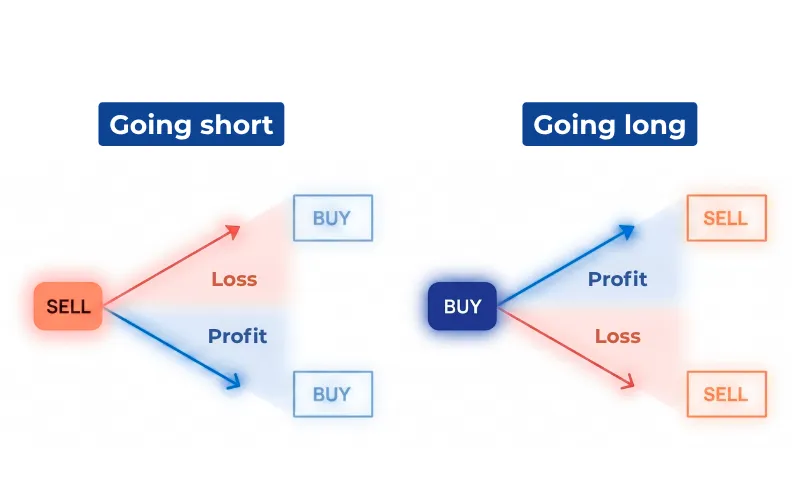
If you believe Apple shares will rise in price over the next week, you open a long position on Apple. If the Apple share price rises by 5%, you profit on that 5% move. If the Apple share price falls 5% instead, you take a loss on that position.
This ability to choose your trade direction is a major difference between CFD trading and standard stock investing. A traditional stock investor can only generate a return when stock prices rise.
A CFD trader can go short to potentially profit from a declining market. However, selling short carries substantial risk, as a rising market will cause a short position to lose money very rapidly.
2.2. Leverage and margin explained
The second core concept controls how you use your money. Leverage provides the ability to control a market position that is significantly larger than your deposited capital.
To access this leverage, you must provide a margin requirement. Margin is the initial cash deposit required by the broker to open and maintain that leveraged position.
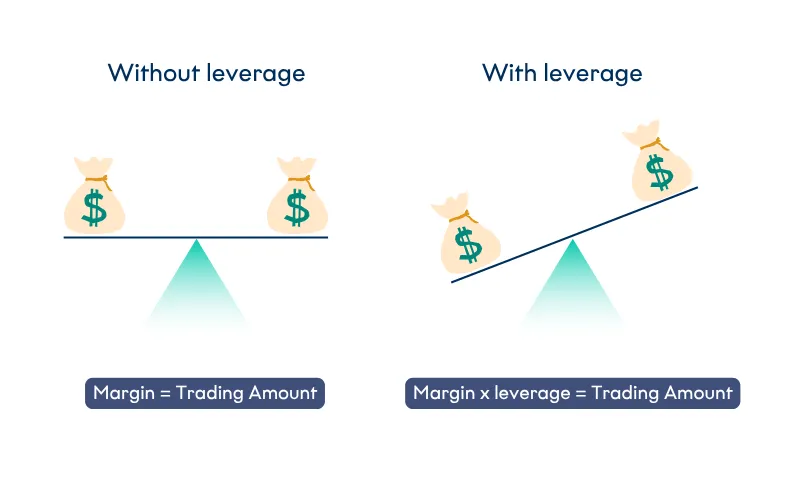
For instance, if a broker requires a 20% margin rate, a $200 deposit allows you to control a $1,000 position in Apple shares ($1,000 * 20% = $200). As another example, a broker offering 10:1 leverage allows a trader to use a $1,000 deposit to control a $10,000 position in the market.
While leverage trading allows for broader market exposure, the system operates on a mathematical reality. Profits and losses are both calculated on the full $10,000 position value, not on the $1,000 margin deposit. If your $10,000 position drops by 10%, you lose $1,000 ($10,000 * 10% = $1,000), completely wiping out your initial deposit.
3. A real CFD trading example: Profit, loss, and all the costs
To see how leverage and fees interact in the real world, we will walk through a complete transaction using a single company stock. Understanding the true mechanics of the market requires looking at both a winning outcome and a losing outcome using the exact same financial setup.
Entering the trade
You decide to buy 100 share CFDs of Company X. The broker quotes a bid/ask price of $99.95 / $100.00. You enter the market by buying at the asking price of $100 per share. Your total market exposure for Company X is $10,000 (100 shares * $100 = $10,000).
Because your broker requires a 20% margin, you must deposit $2,000 to open the trade ($10,000 * 20% = $2,000). At the exact moment of execution, you incur two immediate entry costs:
- Spread cost: The spread is the difference between the buy and sell price. Calculated as (Ask Price - Bid Price) * Number of Shares. In this case, ($100.00 - $99.95) * 100 = $5.
- Commission: A $10 commission is charged directly to your account to open the position. It is important to note that this same commission fee applies to both sides of the trade, meaning you will pay another $10 when you eventually close the position (a total of $20 round-trip).
Scenario A: Profit
Over five days, the price of Company X moves in your favor to $110 per share. Your Company X position is now worth $11,000 (100 shares * $110 = $11,000). Subtracting your opening value from this closing value yields a gross profit of $1,000 ($11,000 - $10,000 = $1,000).
To calculate your net profit, you must subtract all trading costs from that $1,000. You deduct the $5 initial spread, $20 in total commissions ($10 open + $10 close), and $10 in overnight fees.
After subtracting these $35 in total fees from your gross profit, your final net profit is $965 ($1,000 - $35 = $965).
(Note: The overnight fee is calculated as: Position Size * Annual Rate / 365. Assuming a 7.3% annual holding rate for this example: $10,000 * 7.3% / 365 = $2 per day. Over 5 days, $2 * 5 = $10.)
Scenario B: Loss
Instead of rising, the price of Company X falls to $90 per share over five days. Your Company X position drops in value to $9,000 (100 shares * $90 = $9,000). This creates a gross loss of $1,000 ($9,000 - $10,000 = -$1,000).
Trading costs apply regardless of outcome. When the position is already at a gross loss, these fees increase the total loss further. You still pay the $5 spread, the $20 in total opening and closing commissions, and the $10 in overnight fees. Adding these $35 in mandatory fees to your gross loss means your final net loss is $1,035 (-$1,000 - $35 = -$1,035).
Full trade cost breakdown
| Entry price | Spread cost | Commission (open and close) Trading | Overnight fee x days | Gross P&L | Net P&L |
|---|---|---|---|---|---|
| $100 (Outcome A) | $5 | $20 | $10 (5 days) | +$1,000 | +$965 |
| $100 (Outcome B) | $5 | $20 | $10 (5 days) | -$1,000 | -$1,035 |
Reviewing the calculations above reveals the exact break-even point required for this trade. Before your position generates any net profit, the market price must move far enough in your chosen direction to cover the immediate $5 spread and the $20 round-trip commission (a total of $25 in fixed transaction costs). To cover $25 across 100 shares, the asset must rise by $0.25 per share.
This means the moment you open the trade, your immediate break-even price is $100.25. If you hold the position for 5 days (adding $10 in overnight fees, pushing total costs to $35), your break-even price shifts higher to $100.35. If the market stays completely flat at your $100 entry price, your position remains at a financial loss due to these mandatory costs.
(Note: The exact spread values, commission rates, and overnight financing formulas used in this example are purely theoretical and designed for illustrative purposes. Real-world costs, margin requirements, and specific calculation methods will vary depending on your chosen platform and the asset being traded.)
4. The real cost of a CFD trade
Many beginners focus entirely on predicting market direction while ignoring the structural costs of trading. Every transaction carries cumulative fees that will steadily drain your account balance if left unmanaged.
4.1. Spreads: The cost built into every trade
The spread represents the difference between the buy price and the sell price quoted by the broker. The spread is the very first cost charged on any trade and applies the exact moment your position opens.
Spreads generally fall into two categories. Fixed spreads remain constant regardless of market conditions, while variable spreads widen during periods of high volatility, making entry costs unpredictable.
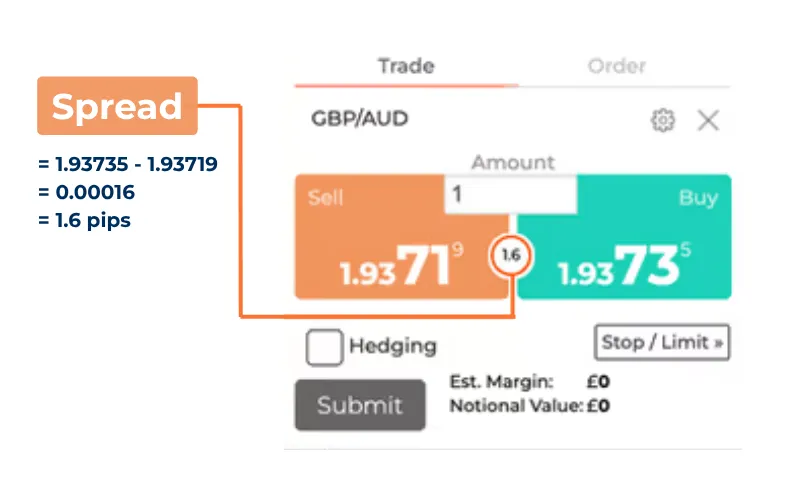
To offer more stability, some brokers specialize exclusively in fixed-spread CFD trading. If predictability is a priority for you, Trade Nation stands out as a prime example, offering fixed spreads across most of its markets. This means your cost of opening a trade remains consistent, shielding you from unexpected fee spikes during sudden market volatility.
For a beginner trying to calculate break-even distances before placing a trade, a fixed spread structure is usually much easier to plan around.
If you want to see exactly how pricing compares across top providers, check out our detailed spread comparison of the 8 best brokers for forex, gold, and indices.
4.2. Commission charges: When you pay to open and to close
Beyond spread costs, some brokers charge a separate commission per trade. Brokers utilizing a commission-based model will charge this fee twice: once when you open the position and again when you close the position.
Other providers build all their operational fees directly into the spread, eliminating separate commissions entirely.
Whether you pay a commission depends heavily on the market you are trading and the account model you selected during registration. Always confirm the fee structure with your broker before entering a market to avoid unexpected closing costs.
4.3. Overnight fees: The silent cost of holding positions
Overnight fees, often referred to as a swap fee or holding cost, represent the financing charge for keeping a leveraged position open past a set daily cut-off time, typically 10 PM GMT.
Calculating an overnight funding fee involves a standard formula:
Position Size x (Benchmark Rate + Broker Markup) / 365.
To tie this back to our earlier example, let’s look at the same $10,000 market position held for 5 days, utilizing the 7.3% total annual overnight rate. The total cost of holding this position is exactly $10.00.
To understand how this number is reached, here is the step-by-step calculation:
- Annual Fee: $10,000 * 7.3% = $730
- Daily Cost: $730 / 365 days = $2.00
- Total Fee: $2.00 * 5 days = $10.00
While this amount seems modest in the short term, the compounding effect over weeks or months can severely damage the profitabilit of medium-term trades.
(Note: Exact markup rates and calculation methods vary by broker, and some may use a 360-day divisor depending on the asset. Because these daily charges combine with your initial spread to put every new trade at an immediate financial deficit, always verify your broker’s specific overnight fees and live spreads before entering the market.)
5. Benefits of CFD trading
When evaluating CFDs, understanding exactly why active traders choose these specific derivative contracts over traditional investing methods provides valuable context. These unique features provide distinct structural advantages, though the features also introduce certain vulnerabilities.
- Leverage: Traders gain access to market positions larger than their deposited capital by using a smaller upfront margin.
- Long and short flexibility: The ability to open positions in either direction means traders can potentially profit whether a chosen market rises or falls.
- Wide market access: Providers cover forex pairs, company shares, market indices, and raw commodities, all accessible from a single account without needing separate specialized brokerage accounts.
- No ownership required: Traders do not need to set up a share registry, hold physical stock certificates, or take delivery of physical commodities to speculate on market prices.
- Tax treatment (jurisdiction-specific): In some countries, derivative gains are treated differently from capital gains on physical shares. (Note: Tax laws vary significantly by jurisdiction. Consult a qualified tax advisor, as this guide does not constitute financial or tax advice.)
- Hedging: Experienced investors sometimes use derivative contracts to offset risk on an existing portfolio position during periods of economic uncertainty.
These features make CFDs appealing for certain market participants. However, each feature also introduces a distinct risk that the next section covers directly.
6. Risks of CFD trading: What every beginner must understand
According to ASIC data, 68% of retail investors lose money trading CFDs. This figure represents a broad industry reality. IG Group, one of the world’s largest CFD providers, explicitly discloses that 69% of retail client accounts lose money when trading CFDs on the IG platform.
This section will explain exactly why these losses happen, moving beyond simple statistics to uncover the mechanical dangers.
6.1. Leverage risk: How losses are magnified
The primary danger lies in the very feature that attracts most participants. If you deposit $200 to control a $1,000 market position (a 20% margin requirement) and the asset rises 10%, the position’s value increases by $100 ($1,000 * 10% = $100). Because you only deposited $200, that $100 gain represents a massive 50% return on your margin ($100 / $200 = 50%).
If the asset falls 10% instead, the position loses $100. This means you have lost 50% of your initial $200 deposit (-$100 / $200 = -50%), even though the broader market only moved 10%.
This leverage risk creates a dangerous scenario where magnified losses escalate extremely quickly. If negative balance protection is not in place on your account, your trading losses can easily exceed your initial deposit, leaving you financially indebted to the broker.
6.2. Gapping, slippage, and counterparty risk: Dangers beginners overlook
Market dynamics introduce secondary risks that frequently catch new traders off guard. Gapping occurs when prices jump instantly between a market’s previous closing price and the next opening price.
This rapid jump can bypass your stop-loss order entirely, forcing the broker to close your position at a significantly worse price than you initially anticipated.
While gapping skips price points entirely, slippage occurs when your market order is executed at a slightly different price than requested, usually during fast-moving economic news events.
Furthermore, participants face counterparty risk. When trading derivatives, you trade directly against the broker. If an unregulated broker becomes insolvent, your account funds may not be protected.
Finally, the ease of opening positions frequently leads to behavioral overtrading, increasing your total market exposure. These market-level risks are significant, but the behavioral patterns in the section below explain the vast majority of the 68% loss rate.
7. Why most CFD traders lose money (and how to avoid it)
The mathematical mechanics of the market only account for part of the high failure rate. The most significant barriers to success are deep psychological and behavioral traps that leverage inherently tends to expose.
7.1. The leverage psychology trap
Because the initial deposit is so small, beginners often forget the real scale of their risk exposure until a severe loss actually hits their account. This creates a dangerous cognitive distortion.
A trader who deposits $500 and opens multiple positions totaling $5,000 in market exposure using 10:1 leverage is not trading with $500. The trader is fully exposed to $5,000 of price movement.
Because of this full exposure, a simple 10% market decline against the combined positions wipes out the entire $500 deposit instantly ($5,000 * 10% = $500). The mathematics do not change based on a trader’s intention. A $5,000 exposure remains a $5,000 exposure regardless of the small deposit size that funded the trade.
7.2. The hidden damage of overnight fees on long positions
As established in the previous cost breakdown, small daily financing charges compound very quickly. This compounding creates a trap for beginners who try to hold active positions for long periods.
A beginner might open a market position expecting a medium-term price move and hold the contract for 30 days. The beginner may be directionally correct about the market trend, but still record a net financial loss because overnight fees consume the profit margin entirely.
For example, a $10,000 position with a 5% annual overnight rate held for 30 days generates approximately $41.10 in fees. This is calculated by finding the daily rate ($10,000 * 5% / 365 = $1.37) and multiplying it by the 30-day holding period ($1.37 * 30 days = $41.10). You must pay this charge steadily, whether your position is currently sitting in profit or sitting in loss.
(Note: Be sure to confirm the exact overnight rates with your chosen broker to accurately calculate holding costs.)
7.3. Overtrading and emotional decision-making
Overtrading means opening market positions too frequently, often driven by the fear of missing out on a sudden market move or the desperate urge to recover a recent financial loss.
Digital trading platforms easily trigger this behavior because fast execution speeds, low minimum deposits, and 24-hour market access eliminate the natural friction that normally slows down impulsive decisions.
To counter this psychological trap, you should define a strict maximum number of simultaneously open positions before you start your session. You must also set your exit parameters before entering a trade, not as a panicked afterthought.
Overtrading is one of the absolute fastest ways to bring your account balance below the broker’s required margin level. The next section explains exactly what happens when that balance drop occurs.
8. What happens during a margin call?
A margin call occurs when the market moves heavily against your position to the point where your available account balance falls below the broker’s required maintenance margin.
When this event happens, the broker issues a formal request for you to deposit additional funds or close open positions immediately to reduce market exposure.
Warning: If you cannot meet a margin call promptly, the broker may close your positions automatically. This automatic closure, sometimes called a stop-out, can lock in your financial loss at the worst possible moment. The margin call process generally unfolds through a standard sequence:
- You deposit $500 and open a leveraged position with $2,500 in total market exposure (using 5:1 leverage, meaning a 20% margin rate).
- The market moves 15% against your position. Your position is now down $375 ($2,500 * 15% = $375).
- Your overall account balance falls to $125 ($500 initial deposit - $375 loss = $125). If the broker’s maintenance margin requirement for this position is 6% of the total exposure, they require you to maintain a minimum of $150 in the account ($2,500 * 6% = $150).
- The broker issues a formal margin call. You must either deposit a minimum of $25 to bring the $125 balance back up to the required $150 ($150 required - $125 current = $25), or close the position at a $375 loss.
- If you do not respond within the required timeframe, the broker automatically closes your position at the current market price to protect themselves from further financial liability.
(Note: Always confirm maintenance margin levels with your chosen broker before placing any leveraged trade to avoid unexpected closures.)
9. How to start CFD trading: 6 steps for beginners
If you decide to proceed after fully understanding the risks, you absolutely must follow a structured setup process. This step-by-step approach prioritizes capital protection and platform familiarity over immediate market action.
9.1. Choose a regulated CFD broker
Broker selection is the single most consequential decision you will make, as an unregulated entity offers zero legal investor protections. When evaluating providers, verify their regulatory status, analyze their spread structures, test the platform usability, and confirm their legal availability in your country.
Use this evaluation checklist to filter your options:
- Is the broker directly regulated by a recognized authority such as the FCA, ASIC, or ESMA?
- Are spreads fixed or variable? Which spread structure is more predictable for your trading style?
- Is a free demo account available before you must fund a live account?
- What is the absolute minimum deposit?
- Are stop-loss and take-profit order tools available as standard interface features?
For example, brokers like Trade Nation are heavily regulated across multiple jurisdictions (including the UK FCA and Australia ASIC). This level of regulatory coverage ensures the broker is subject to strict conduct standards, strict capital requirements, and client fund protection rules in each region.
When evaluating any broker, you can cross-check their regulatory status directly on the relevant regulator’s official public register.
9.2. Open and fund your account
You must complete an online application and submit standard identity verification documents, such as proof of identity and proof of address, to open an account.
Once the broker verifies your identity, you make an initial deposit. Brokers generally support various payment methods, including Visa, Mastercard, Skrill, and Neteller.
Start with the absolute smallest available deposit until you are fully comfortable with the platform mechanics and the aggressive nature of leveraged positions under live conditions.
This is where platforms like Trade Nation become highly practical for beginners, as they do not enforce a strict minimum deposit. You are free to fund your account with just enough to cover the margin of your first small trade, keeping your initial risk extremely low.
9.3. Practice with a demo account first
Practicing in a simulated environment before committing real capital is the most actionable risk-reduction step available to you. A demo account provides virtual funds but closely mirrors real market prices.
This simulated environment allows you to learn the interface, test your trade logic, and carefully observe how leverage impacts your balance without any financial danger.
We recommend spending at least two to four weeks on a demo account before funding a live account. However, you must remember that the absence of real financial stakes heavily changes human decision-making, meaning demo success does not guarantee live profitability.
9.4. Choose your market
CFD providers typically divide their offerings into four primary categories: forex pairs, broad indices, individual company shares, and raw commodities.
As a beginner, you will generally find the most stability by starting with major forex pairs like EUR/USD or major indices like the S&P 500, as these heavily traded markets carry the tightest spreads and deepest liquidity.
While commodities offer opportunities, note that providers often use variable spreads on these instruments, causing your trading costs to fluctuate heavily with market conditions. Furthermore, you should avoid cryptocurrency CFDs, as extreme price volatility combined with high leverage creates an exceptionally high risk of rapid capital loss.
9.5. Set your stop-loss and take-profit orders
A stop-loss order is an automatic instruction that closes your market position if the price moves against you by a specified amount, securely limiting the maximum potential loss on a single trade. A take-profit order does the exact reverse, automatically closing the position when the market price reaches a specified profit target.
You must set both orders before opening a position, rather than adding them reactively after you are already stressed by an active trade. Most regulated CFD brokers provide stop-loss and take-profit order tools as standard, easily accessible features on their platforms.
9.6. Monitor and close your position
To close an active CFD position, you simply execute the exact opposite trade. If you bought an asset to open a long position, you sell the same asset to close the position.
CFD positions generally do not expire by default, but overnight fees accrue against your account for every calendar day the position remains open past the daily cut-off time.
Check open positions regularly because leveraged conditions change extremely quickly, but avoid monitoring positions so obsessively that you trigger the emotional overtrading behaviors discussed earlier.
10. CFD trading strategies: An overview for beginners
A formal trading strategy is a rigidly defined set of rules for entering, managing, and exiting positions. Without a formal strategy, your market activity becomes entirely reactive and emotionally driven.
10.1. Day trading
Day trading requires you to open and close all market positions within the exact same trading session to ensure you never hold positions overnight. This strategy completely eliminates the overnight fee exposure.
Day trading strongly suits individuals who can monitor their screens for extended periods and make quick decisions based on intraday price movements. The primary risk is that without a rigid, rule-based framework, you can quickly let day trading devolve into destructive overtrading.
10.2. Swing trading
Swing trading involves holding active positions open over several days to several weeks to successfully capture medium-term price trends. This approach suits individuals who base their trading decisions on analysis done outside of active market hours, making swing trading compatible with a full-time job schedule.
The main risks you face include the heavy accumulation of overnight fees and the danger of unexpected news events causing significant weekend price gaps that completely bypass your safety orders.
10.3. Scalping
Scalping targets very small price moves across a high volume of trades, keeping positions open for only minutes or even seconds. This aggressive strategy requires advanced execution skills, ultra-low spreads, and advanced technical knowledge.
For a beginner, the mandatory spread cost will frequently exceed the target profit on each rapid trade, making the scalping strategy capital-destructive. We strongly do not recommend scalping for beginners.
CFD Strategy Comparison
| Strategy | Time horizon | Typical trade duration | Skill level required | Risk level | Best market conditions |
|---|---|---|---|---|---|
| Day trading | Intraday | Minutes to hours | Intermediate to advancede | High | Trending markets with high liquidity |
| Swing trading | Days to weeks | 2-10 days | Intermediate | Medium-high | Trending markets with clear momentum signals |
| Scalping | Ultra-short | Seconds to minutes | Advanced | Very high | High-volatility, high-liquidity sessions with tight spreads |
11. What markets can you trade with CFDs?
Modern digital platforms consolidate your access to various global asset classes into a single, unified dashboard.
- Forex: The exchange of global currency pairs, such as the EUR/USD pair or the GBP/USD pair, representing the most liquid market by daily volume.
- Indices: Baskets of company stocks that track broader market performance, such as the S&P 500 index or the FTSE 100 index.
- Shares: Individual company stocks, such as Apple shares or Amazon shares, allowing you to use position sizes significantly smaller than buying full physical shares.
- Commodities: Raw materials and physical goods, including gold, crude oil, and natural gas.
While cryptocurrency derivatives clearly exist on some platforms, their extreme volatility makes the digital assets highly dangerous. (Note: Always check availability with your broker and confirm that cryptocurrency derivatives are legally permitted in your jurisdiction.)
12. CFDs vs. stock investing: The key differences
CFD trading and standard stock investing serve entirely different financial purposes. The table below highlights the deep structural distinctions between trading derivative contracts and holding physical assets.
| Criteria | CFD trading | Stock investing |
|---|---|---|
| Own the asset? | No | Yes |
| Leverage available? | Yes | No (typically) |
| Short selling? | Yes, freely | Requires a specialized margin account |
| Overnight fees? | Yes | No |
| Suitable for beginners? | High learning curve, significant risk | Generally more forgiving |
| Available in the US? | Banned for retail traders | Yes |
Which approach suits your goals depends heavily on your risk tolerance, available time horizon, and general familiarity with aggressive leveraged products.
13. How to verify your broker is regulated
Never take a provider’s marketing claims at face value. You should use this independent verification process to ensure your funds are securely protected:
- Locate the broker’s regulatory claim, which is typically stated in fine print in the footer of their official website.
- Visit the relevant regulator’s public register. For the FCA, use register.fca.org.uk. For ASIC, use search.asic.gov.au.
- Search by the company name or the exact licence number provided on the website.
- Confirm the official status reads “Authorised” rather than just “Registered” and securely ensure the permitted services match the actual products the broker offers.
Note: If you cannot find a broker’s name or licence number on the relevant official regulatory register, do not fund an account with them under any circumstances.
14. Popular CFD trading platforms for beginners
Selecting a reliable provider ensures the broker securely handles your capital and fairly executes your market orders. Below is a short list of well-known, regulated CFD trading platforms that serve different types of traders globally:
- IG: Operating as one of the largest global providers, IG offers an extensive range of financial markets and advanced charting tools suited for traders looking for deep market access and heavy research data.
- Trade Nation: Recognized for its highly transparent cost structure, this broker specializes almost entirely in fixed-spread CFD trading. Because it eliminates the anxiety of fluctuating fees, Trade Nation is an exceptionally strong option for beginners who prioritize predictable trading cost s alongside top-tier regulatory oversight.
- OANDA: Broadly known for strong forex offerings, OANDA provides reliable trade execution and detailed economic analysis tools.
- Plus500: The Plus500 platform features a streamlined, user-friendly mobile application, though Plus500 caters more to traders who prefer a minimalist interface without complex research terminals.
15. FAQs about CFD trading
Why is CFD trading illegal in the US?
The SEC and CFTC do not legally authorize over-the-counter derivatives like CFDs for retail investors in the United States. The regulatory framework in the US heavily prefers exchange-traded instruments, such as standard options and futures, which offer higher transparency and centralized clearing.
Is CFD trading good for beginners?
CFD trading carries significant risks for beginners, reflected clearly in the 68% retail loss rate from ASIC data. The harsh combination of mandatory spread costs, accumulating overnight fees, leverage risk, and behavioral traps creates a very steep learning curve that makes consistent profitability difficult for true novices.
What is the difference between CFD trading and investing in stocks?
The main structural differences are that CFD traders do not own the underlying physical asset, can easily open short positions to bet against the market, pay daily overnight financing fees, and heavily utilize leverage to increase exposure, none of which strictly apply to standard stock investing.
What is a margin call in CFD trading?
A margin call occurs when your overall account balance falls below the broker’s minimum required maintenance margin due to heavy market losses. The broker will formally demand that you deposit additional funds immediately, or the broker will automatically close your positions to lock in the loss and actively prevent further liability.
Can I practice CFD trading before risking real money?
Yes. Most regulated CFD brokers legally provide a free demo account that accurately simulates live market conditions using virtual funds.
How much money do I need to start CFD trading?
The absolute minimum deposit varies by broker, with some digital platforms allowing initial deposits as low as a few tens of dollars. However, a very small account balance provides minimal margin buffer, meaning even a small adverse price move can trigger an immediate margin call.
16. Conclusion
The reality of the derivative market is that derivative trading is not a simple or guaranteed path to outsized financial returns.
The 68% retail loss rate is not a reflection of individual intellectual failure, but rather a harsh reflection of the genuine structural difficulty of achieving consistent profitability in aggressive, leveraged environments.
The heavy cost structure of spreads, commissions, and overnight fees means every single position starts at a financial deficit that you must overcome before you realize any net profit.
Risk management tools like stop-loss orders, careful position sizing, and thorough demo account practice are not optional extras; you must use these tools to build the minimum required infrastructure for market survival. Furthermore, ensuring strong regulatory status remains the first and most critical filter when you select any broker.
If you are considering taking the next step, setting up a free demo account is the most practical and lowest-risk way to accurately experience the mechanics of CFD trading before committing real capital to live markets.